
The smelting process for black silicon carbide (SiC) mainly employs the Acheson process, a high-temperature resistance furnace smelting method. The main process flow is as follows:
1. Raw Material Preparation
Main raw materials: Quartz sand (SiO₂ content ≥ 98%) and petroleum coke (carbon content ≥ 98%), with small amounts of sawdust and sodium chloride (NaCl) as auxiliary materials.
Proportioning: Based on the silicon carbide reaction formula SiO₂ + 3C → SiC + 2CO↑, in actual production, a slight excess of carbon (approximately 3-5%) is required to compensate for oxidation losses.
Pretreatment: Raw materials need to be crushed and sieved to suitable particle sizes (typically 0.5-5mm for quartz sand and 0.2-2mm for petroleum coke), and mixed evenly.
2. Furnace Loading and Core Preparation
Furnace structure: Rectangular or circular fixed resistance furnace, with refractory bricks lining the bottom and removable side walls.
Furnace Core: A conductive furnace core made of graphite powder or recycled silicon carbide material (serving as the heating element) is laid in the center of the furnace body.
Charging: The mixture is layered and filled around the furnace core, and the outside is covered with insulating material (such as coke powder or quartz sand) for heat preservation.
3. Electrolytic Smelting
Electrical Heating: A low voltage and high current (approximately 5000-10000A) are applied through the electrodes at both ends of the furnace core, gradually raising the furnace core temperature to 2000-2500℃.
Reaction Process:
Starting at approximately 1400℃, SiO₂ is reduced by carbon to produce gaseous SiO and CO:
SiO₂ + C → SiO↑ + CO↑
Gas-phase SiO reacts with carbon to form SiC:
SiO + 2C → SiC + CO↑
Ultimately, a silicon carbide crystalline layer forms around the furnace core.
Smelting Time: Continuous energization for approximately 24-40 hours, the specific time depending on the furnace size and power.
4. Cooling and Furnace Dismantling
Natural Cooling: After a power outage, the furnace body needs to cool slowly (approximately 7-14 days) to prevent rapid cooling that could cause crystallization cracks.
Furnace Dismantling: Remove the insulation layer and extract the silicon carbide crystalline blocks.
5. Grading and Processing
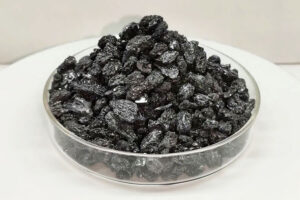
Core Area Product: The area surrounding the furnace core consists of high-purity black silicon carbide crystalline blocks (α-SiC, hexagonal crystals).
Layered Processing:
Grade 1: Dense crystalline zone, SiC content ≥97%, used for manufacturing high-end abrasives and refractory materials.
Grade 2: Contains more impurities, used as metallurgical additives, etc.
Amorphous Zone: Incompletely reacted mixture, recyclable.
Subsequent Processing: Crushing, screening, acid washing (to remove metallic impurities), magnetic separation, hydraulic classification, etc., to obtain finished products of different particle sizes.
6. Key Auxiliary Processes
Wood Chips: Increase the permeability of the furnace charge, facilitating CO gas discharge.
Use of Salt: It reacts with impurities such as aluminum and iron in the raw materials to form chlorides that volatilize, thus purifying the material.
Waste Gas Treatment: Smelting generates a large amount of CO gas, which needs to be collected, utilized, or burned to prevent pollution.
Process Characteristics and Challenges:
High Energy Consumption: Producing 1 ton of silicon carbide consumes approximately 8000-10000 kWh of electricity.
Critical Temperature Control: Insufficient temperature leads to incomplete reaction, while excessive temperature causes SiC decomposition.
Environmental Requirements: CO gas and dust must be treated; modern processes often include waste heat recovery systems.
Modern Improvement Directions:
Larger Furnace Type: Increase single-furnace output (up to thousands of tons).
Automation Control: Optimize the power-on curve to reduce energy consumption.
Green Smelting: Waste gas recovery for power generation, waste recycling.